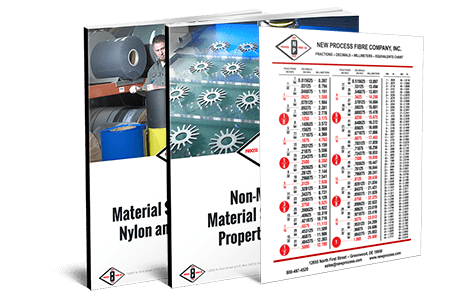
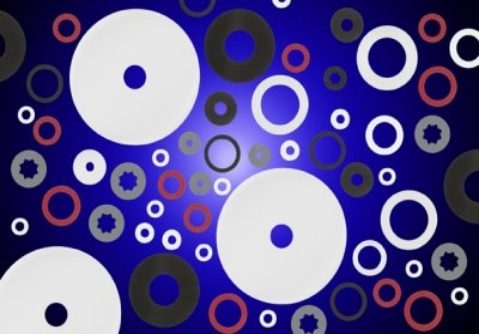
With more than 10,000 washer dies in-house and 75 conventional and high-speed punch presses intended to punch both strip and coil stock, New Process Fibre is well-equipped to handle standard and custom part orders of any size. Ready to handle requests ranging from a single part to multi-millions, our team is experienced in production with a broad variety of materials.
We have a wide selection of materials in stock, including Acetal, Buckfab, Delrin®, Epoxy Glass, Fish Paper, Mylar®, Nomex®, Nylatron®, Nylon MDS, Nylon 6 and Nylon 6/6, Phenolic, Polyethylene, Polypropylene, Teflon™ PTFE, PEEK®, PVC, UHMW, Ultem®, Vulcanized Fibre, and much more.
New Process Fibre can form custom washers, spacers, tags, end laminations, gaskets, insulators, and many other specialized parts in an array of color options.
- CAD files accepted
- Short and High Run Stampings
- In-house prototype runs using steel rule dies for die cutting
- Progressive Stampings
- Custom Die creations
- Special shapes, such as diamond, oval, triangle, rectangle, round, and many more
- Critical tolerances achieved, specifically for thicknesses from 0.005” to 0.250” and formed parts as small as 0.093” in diameter to as large as 24” square
- Embossing/screen printing/nomenclature on custom parts
- PPAP (Product Part Approval Process) available
- Pressure Sensitive Adhesive (PSA) applied to stamped parts
Precision Stamped Parts for High-Volume and Custom Manufacturing
Stamped parts are widely used throughout industrial and commercial products because they provide a repeatable manufacturing method for producing components with consistent dimensions and performance characteristics. Whether a project requires prototype quantities or large-scale production runs, precision stamping can support high-volume manufacturing while maintaining tight tolerances and material consistency.
New Process Fibre produces stamped components from a broad range of non-metallic and engineered materials, allowing customers to source application-specific parts designed around performance requirements, dimensional specifications, and assembly needs.
Material Selection and Application Requirements
Selecting the appropriate material is one of the most important decisions in any stamped part project. Material properties can influence wear resistance, electrical insulation, moisture resistance, temperature performance, chemical compatibility, and overall product longevity.
Common factors considered during material selection include:
- Operating temperature
- Electrical requirements
- Environmental exposure
- Chemical resistance needs
- Wear characteristics
- Load requirements
- Thickness requirements
- Regulatory specifications
Evaluating these criteria helps ensure the finished part performs as intended within the larger assembly.
Components Commonly Produced Through Precision Stamping
Stamped parts serve a wide variety of functions across industrial products and equipment. The versatility of the stamping process allows manufacturers to produce both simple and highly specialized components.
Common stamped products include:
- Flat washers
- Insulating washers
- Spacers
- Shims
- Gaskets
- Seals
- Tags
- End laminations
- Electrical insulators
- Wear pads
- Custom identification components
- Application-specific specialty parts
Many of these components are designed to meet unique dimensional or material requirements that are not readily available from standard off-the-shelf products.
Prototype Development and Design Validation
Early-stage development often benefits from prototype production before transitioning into larger manufacturing volumes. Prototype runs allow engineers and purchasing teams to evaluate dimensions, fit, assembly compatibility, and overall functionality before finalizing production tooling.
This process can help identify opportunities for refinement while supporting a smoother transition from concept development into volume manufacturing.
Frequently Asked Questions
What Types of Parts Can Be Produced Through Precision Stamping?
Precision stamping can be used to manufacture washers, spacers, gaskets, insulators, tags, laminations, seals, and a wide variety of custom components.
What Materials Are Available for Stamped Parts?
Stamped components can be produced from numerous engineered plastics, fiber materials, insulation materials, laminates, and other non-metallic materials depending on application requirements.
Can Stamped Parts Be Produced from Customer-Supplied CAD Files?
Yes. CAD files can help support part development, tooling creation, prototyping, and production planning.
What Is the Benefit of Prototype Stamping Runs?
Prototype runs allow engineers to verify fit, function, and dimensional requirements before committing to full production quantities.