New Process Fibre has been stamping and die cutting non-metallic washers, spacers, gaskets, shims, and many other custom shapes for a variety of customers since 1927.
At our 55,000 square foot facility, we provide quality and service to our customers that add value and provide a competitive advantage to their projects in the aerospace/military, construction, industrial, archery, automotive, electronic, fastener, furniture, hunting, fishing, elevator, power hand tool, plumbing, marine, transformer and numerous other industries.
We offer a wide array of colors, including red, green, blue, yellow, black, orange and white; color matching is also available on certain materials. (Minimum quantities may apply for special colors.).
New Process Fibre specializes in standard and custom non-metallic component fabrication. For nearly 100 years, we have been providing our customers across various industries with high-quality gaskets, shims, spacers, washers, and other non-metallic components. Today, our 55,000-square-foot facility offers several in-house services for excellent quality control and efficient fabrication. These services include:
- The application of pressure-sensitive adhesives (PSA) onto stamped parts
- Embossing, screen printing, and adding nomenclature to custom products
- In-house tool and die making
- Non-metallic stamping
- Sheet extrusion and slitting
- Slitting and shearing
We provide materials and stamped goods in English or metric units. As a proud leader in fabrication services, New Process Fibre creates custom fabrications for multiple industries, including the following:

- Aerospace
- Archery
- Automotive
- Construction
- Electronic
- Elevator
- Fastener
- Fishing
- Furniture
- Hunting
- Industrial
- Marine
- Military and defense
- Plumbing
- Power hand tool
- Transformer
Material Expertise
With our team of experts, New Process Fibre will help determine the right materials for your project, meeting the aims of the end application as well as any budgetary goals. We can also source specialized non-metal materials for custom projects with detailed specifications, including Buckfab and Kraftpaper. Though experienced with a wide range of materials, we commonly work with non-metal substrates such as vulcanized fiber, thermoplastics, and laminates.
- Vulcanized fiber.This non-metal fibrous material is composed of organic products, such as wood pulp, paper, and rags. Because of its high flammability ratings, manufacturers commonly use vulcanized fiber for automotive components or electrical insulation. Other positive characteristics of this material include resistances to impact and abrasion damage. Tough and resilient, vulcanized fiber often serves as an ideal material for gaskets or washers in various applications.

- Unlike thermoset plastics, which can’t be changed or reformed after curing, thermoplastics are more versatile. Waste or excess material from production can be collected and reused in future projects, making thermoplastics an affordable material for high-volume production of consumer goods and industrial parts alike. Popular thermoplastics include acetal copolymer, high-density polyethylene (HDPE) and low-density polyethylene (LDPE), nylon MDS, nylon 6, polyethylene copolymers, and polyethylene homopolymers. Each thermoplastic has unique characteristics that our product experts can help match to any custom product requirements.
- Laminates are made from different resins, each with different chemical, electrical, and mechanical characteristics that change the material’s ability to perform in various applications. The National Electrical Manufacturers Association (NEMA) grades laminates on the performance for different environments. Laminates are useful in a variety of aerospace, automotive, electronics, industrial, and petroleum field applications.
Besides the above offerings, New Process Fibre has an even wider variety of available specialty materials for non-metallic stamped components. If you would like to know about the availability of a specific material, please don’t hesitate to ask.
Machinery and Equipment
At New Process Fibre, our facility stays outfitted with top-of-the-line specialty equipment, ensuring we always have the tools we need to fulfill high-volume and high-speed orders on even the most complex projects. Our high-performance Bruderer stamping press machines deliver high-accuracy, precision, and speed, even with complex product designs and difficult materials.
The key to our Bruderer machines is the responsive clutch and brake units that allow for small, precise changes. With the first-punch accuracy our equipment offers, we can consistently guarantee high quality from start to finish. As part of our quality assurance efforts, our machinery stays well-calibrated and consistently maintained.
Key Benefits of Working With New Process Fibre
As an industry leader in providing non-metallic stamping manufacturing services, New Process Fibre offers significant insight and exceptional delivery on product design and development. Our custom fabrication projects always excel at providing our clients with high-performing parts that match their desired applications, end-use environment, and budget. During each stage of the project, our team works with each customer to provide support. As always, throughout fabrication, our technical experts ensure every production run maintains precision and timeliness with our top-notch equipment.
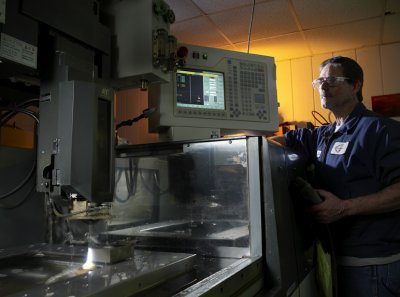
At New Process Fibre, our top priorities remain innovation and quality. We continuously seek new ways to improve product quality and increase cost-effectiveness so our clients benefit from increased value within their budget. Not only are we an ISO 9001 certified manufacturer, but we also provide in-house services, such as fabrication and tooling with EDM capabilities. Finally, we extrude our own thermoplastics to maximize quality control and create consistent results during every stage of a production project.
Extruded Thermoplastics For Custom Material Requirements
Plastic extrusion allows thermoplastic materials to be manufactured in continuous sheet and roll formats that can later be converted into finished components. By producing material to application-specific dimensions, manufacturers can start with stock tailored to their production requirements rather than relying solely on standard sizes.
Common advantages of custom extrusion include:
- Custom thickness ranges
- Application-specific roll widths
- Consistent material properties
- Color matching capabilities
- Improved material utilization
- Support for downstream converting operations
- Scalable production volumes
- Availability across multiple thermoplastic materials
These capabilities help manufacturers source material that aligns with both product performance requirements and production objectives.
Precision Slitting For Efficient Material Processing
Slitting is a material conversion process that transforms wider rolls into narrower widths based on customer specifications. This process plays an important role in preparing thermoplastic materials for downstream manufacturing operations where specific roll widths may be required for production equipment, handling procedures, or converting processes.
Material supplied in the proper width can simplify processing by reducing additional trimming and preparation steps before fabrication begins. Slitting also allows manufacturers to optimize material handling throughout stamping, die cutting, laminating, and other high-volume production activities. By providing material closer to the required processing dimensions, slitting supports more efficient manufacturing workflows and improved consistency throughout production.
Frequently Asked Questions
What Is Plastic Sheet Extrusion?
Plastic sheet extrusion is a manufacturing process that produces continuous thermoplastic sheets or rolls by forming molten material into a controlled thickness and width.
What Is Material Slitting?
Slitting is the process of converting wider rolls of material into narrower widths that are better suited for specific manufacturing or converting operations.
Why Is Custom Roll Width Important?
Custom roll widths can help improve production efficiency, reduce material handling requirements, and support compatibility with downstream equipment and fabrication processes.
What Materials Can Be Extruded Into Sheets And Rolls?
Many thermoplastics can be extruded into sheet and roll formats, including polyethylene, polypropylene, nylon, acetal, and other engineered materials.
Contact Us Today to Get Started
Non-metal washers and other stamped industrial components make an ideal solution for any circumstances that require corrosion-resistant and versatile materials. Since 1927, our family company has continued its tradition of innovation and commitment to quality in stamping high-quality parts. With attention to equipment, material selection and processing, as well as manufacturing, New Process Fibre strives to meet any custom fabrication and non-metallic stamping demands. Contact our team today to learn more about our capabilities or request a quote to start your order.